Easy Payment Service Implementation
Boosting Conversion by over 75%
Reduced time 42s →6s
- Role
- Product designer
- Team
- PM
- Product Designer
- Developer1
- Methods & Tool
- Problem Definition
- Hypothesis Setting
- Competitor Analysis
- Figma
- Practices
- User Research
- UXUI design
- Usability Testing
- Prototyping
- Timeline
- Overall : 2months half
- Discovery & Research : 1 week
- Design & iterations : 3 times
Overview
Why Implement an Easy Payment Service on The Hyundai App?
- Service OverviewThe Hyundai.com is Hyundai Department Store’s online platfrom. offering premium services for VIP customers and fresh groceries.Through short-form and live content, it delivers the department store experience in real time.
- Project IssuePurchase conversion rate was 28%, and it took customers over 42s from product selection to purchase
completion, resulting in high drop-off. GA data analysis identified the order form as the main drop-off point. - Project Objective
Conversion Rate :
Up to 50%from Previous
Optimized Purchase time :
Checkout Within 10s
- Target AudiencePrimary Users : Women aged 40–50. Top Membership Segments by Purchase Conversion and Revenue
Summary
Refined through three design iterations informed by user insights and analytics,
the Easy Payment Service was launched with optimal quality.
Iteration
Problem Definition
Decision
Result
Low purchase conversion rate
→ Conversion rate 28%
Hypothesis-driven design :
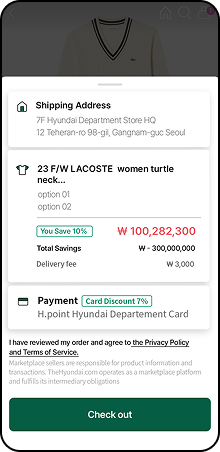
Implemented Easy Payment via bottom sheet UI
Customer validation :
Redesigned checkout UX for faster payment
The information hierarchy needs to align with the user flow
Internal test :
Reorganize payment information architecture prioritizing user verification needs over structural alignment.
Customer validation :
Reduced hesitation and friction during checkout.
32 day post-launch analysis revealed 17% cancel-repurchase loop
Customer-validated benefits :
Delivered H.point usage &discount benefit details based on GA data driven
Customer validation :
Conversion rate increased by 75% time reduced under 10s
Iteration 1_ Speed Over Perfection
With a purchase conversion rate of 28% and over 42s required from product selection to checkout,
we observed significant user drop-off at the pre-purchase order form stage.
Chose fast iteration and deployment over a full checkout restructure to drive immediate conversion gains.
Preserved structure, optimized layout
Fixing the Pay button will likely increase the purchase conversion rate.
Redesigned structure, reduced information
Minimizing the need to scroll would improve the purchase conversion rate.
Development constraint :
Complex code structure prevented full order form redesign within timeline. Preserved structure, optimized layout
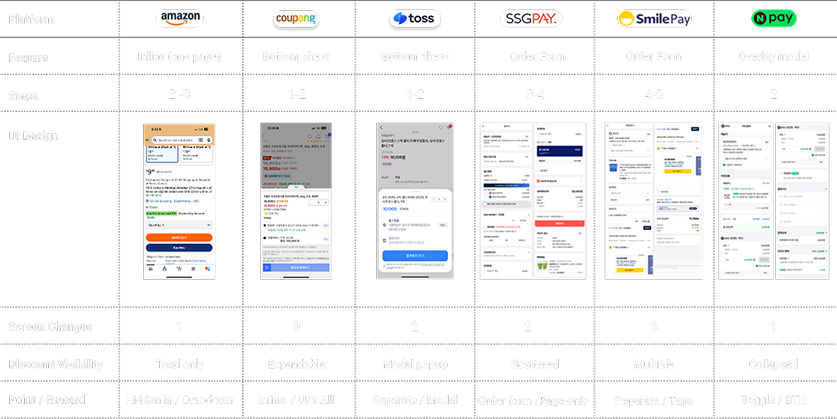
Platform Benchmarking : Why Bottom Sheet Works
Coupang's bottom sheet model selected as optimal_other platforms use order form redirects
Keeping consistent with the existing order form while guiding users
toward a faster checkout flow with minimal changes.
Iteration 2_Reframing Information Hierarchy
After introducing the simplified payment UI, users still experienced confusion due to unclear information hierarchy during checkout.
Through customer validation interviews, we restructured the information hierarchy around customer priorities and eliminated UI friction points in the payment flow.
User interviews indicated that customers primarily focused on final payment amount, applied discounts, and delivery information when confirming payment.
- Insight 01
Over 50% prioritize the final payment amount,
followed by product info and discount details.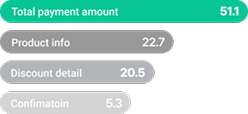 Age 2030s (2 participants)
Total amount → Product info → Discount details
→ Shipping confirmation - Insight 02
Shipping is generally just quickly confirmed
unless it’s a special case like gift delivery.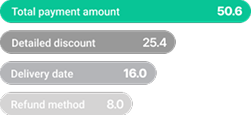 Age 40s (3 participants)
Total amount → Detailed discount → Delivery date
→ Refund method
Structure key information based on customer priorities :
→ Product info (total amount & discounts)
→ shipping info
→ Payment method toward a
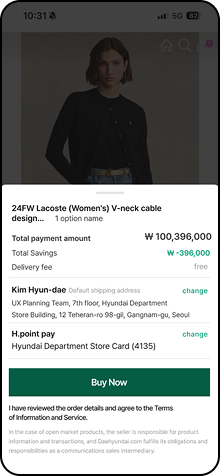
·Improved clarity during the payment step.
·Reduced hesitation and friction during checkout.
·Established a clearer foundation for further data-driven optimization.
Iteration 3_Data-Driven Refinement & Conversion Impact
Post-launch analysis over 32 days showed that 17% of completed
orders involved a payment cancellation followed by re-entry and repurchase.
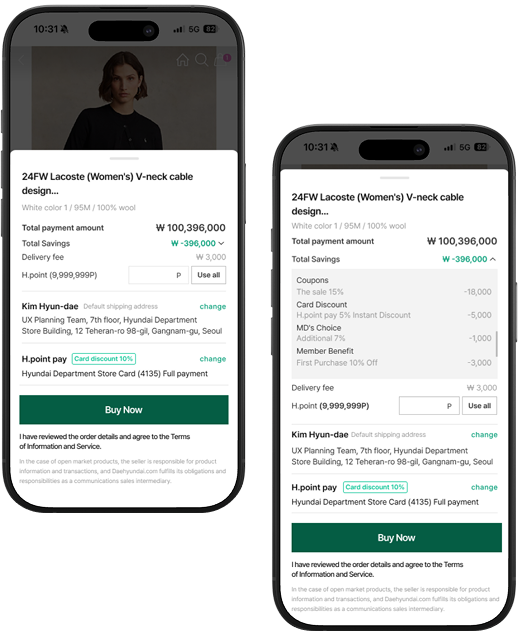
Integrated H.Point and detailed discount visibility into payment
flow, boosting Purchase Converison Rate(PCR) by 75% and reducing checkout time to 6s.
Out of 250 total, 43 canceled payments GA4 data from March 27 – April 28 (32-day funnel analysis)
- Check
discount details25- ·
- Users receive 5 base discount benefits, and as high-involvement products include more product discounts, VIP discount details become increasingly important.
- Using
H.point rewards18- ·
- H.point is Usable on & offline and affiliates.
- ·
- Points can be used like cash (₩), from 1 up to 9,999,999 points.
User interviews (Age 20s - 40s)
- Core users, particularly mid-aged female
customers, showed a strong tendency to carefully
re-verify discounts and rewards at the final step. - Interviews confirmed that missing or unclear benefit
information increased hesitation right before payment,
even when purchase intent was high.
·Exposed H.Point balance and usage status at the payment stage
·Expanded discount details in a structured, scannable layout to support quick verification without leaving the flow.
01.Discount benefits details
Maximum discount benefits visible
on a single screen without scrolling.02. Using H.point rewards
Input field and use full amout button
for instant point application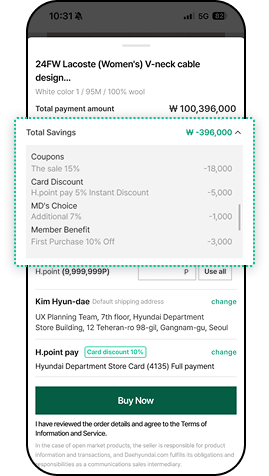
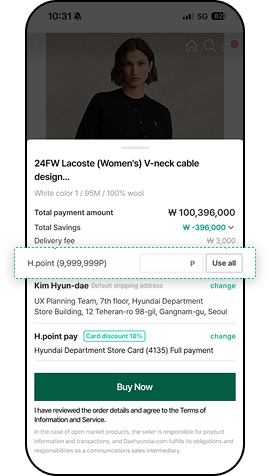
Design prototype test process for expanded discount details
Tooltip
Advantage :
Easily viewable within a single area.Issue :
Cannot accommodate maximum
benefits due to lack of scrolling.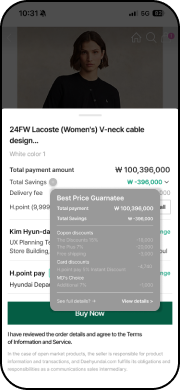
Full popup
Advantage :
Complete benefit visibility and clear messaging.Issue :
Close button creates an additional hurdle, increasing drop-off risk.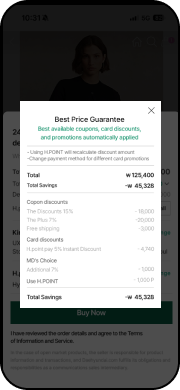
Dropdonwn
Resson to choosen :
Single-screen checkout,
all info visible, no navigation needed..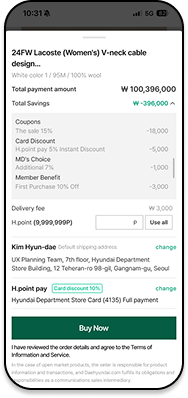
Drove 75% MoM increase in Purchase Conversion Rate and
Reduced payment time to 6s (GA4 funnel analysis: May 29 – Jun 29)
Conversion rate
Completed paymentsessions : +11,452
+75%
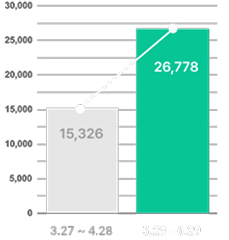
Check out time
Payment time : -36 seconds vs. baseline
42s → 6s
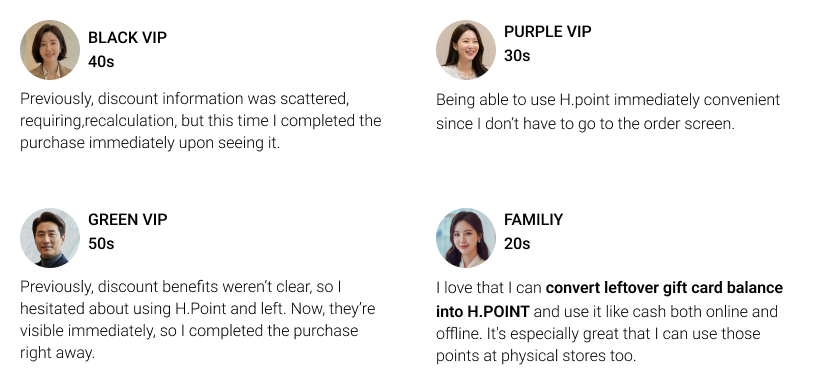
Validated discount details and H.Point usage as critical customer needs through
5 in-depth interviews across membership tiers (general to VVIP, ages 20-40).
Reflections
analysis highlighted the need for more thorough research validation and sufficient testing before launch.
Missing analysis of customer-preferred
areas based on the initial order form.
In focusing on scroll and button fixation in the existing order form,
I overlooked a more detailed analysis of the Payment Zone Information
Check (Iteration 1)
Overlooked the detailed analysis of
customers by membership type on the
Hyundai.com platform.
There was a lack of analysis on why customers
at different membership levels.
Why was this overlooked
in customer interviews?
The oversight occurred because the interview questions were
primarily focused on addressing the initial design issues,
without delving into the existing order form’s functionality.
Need for more refinement
during the research phase.
Refined research is needed, including not just
customer interviews and tests, but also behavior analysis.
 Prev
Prev